
Tekapo ground wētā
Status: Nationally Critical
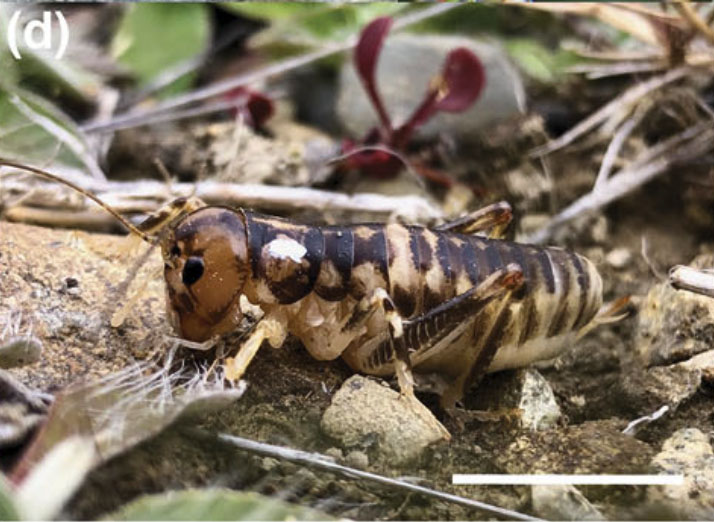
Wētā is the common name for a group of large flightless crickets—some of the heaviest insects in the world—endemic to New Zealand. Generally nocturnal, they have filled ecological niches that elsewhere in the world are inhabited by mammals. Smaller wētās generally are carnivores and scavengers while the larger species are herbivorous. Some live in caves, other on trees, and yet others live and/or burrow underground. Several, including the Tekapo ground wētā (Hemiandrus fabella*), are critically endangered.
Description
Most of the Hemiandrus species hide in burrows in the ground during the day and those that live in open ground conceal their exit holes with a specially made perforated door. During the night, ground wētā hunt invertebrate prey and eat fruit.
The Tekapo ground wētā was discovered in 1992 during an invertebrate sampling study on and around the Tekapo River delta (part of the upper Waitaki catchment). It appears to live only in this area along river margins, where it burrows in the silty soils. It usually prefers the terraces above normal flows and small floods but is susceptible to more severe flooding.
Detailed anatomical photos (Fig. 6 p12) and a discussion of what distinguishes this wētā from others can be found here.
More information & research
- 2026 *Trewick & Morgan-Richards, Five New Species of New Zealand Hemiandrus Ander 1938 Ground wētā (Orthoptera: Anostostomatidae), New Zealand Journal of Zoology (open access)
- 2019 (DOC): Management and Research Priorities: terrestrial invertebrates, lizards, terrestrial native plants, terrestrial weed invasions, and geomorphology, wetlands, river mouths and estuaries
- 2016: Mackenzie weta species edges closer to extinction (NZ Herald)
- 2015: Smith; Evolution of diversity: analysis of species and speciation in Hemiandrus ground wētā PhD thesis Massey University, New Zealand
- 2014: Terrestrial ecology assessment Benmore irrigation scheme (Tonkin & Taylor)
- 1995 Wyngaarden: The ecology of the Tekapo ground wētā…and recommendations for the conservation of a close relative (MSc thesis, University of Canterbury)
- Terra Nature
- See Ecology/invertebrates for further information and references
- See also Ecology/further information and references