
Robust grasshopper
Status: Nationally Endangered
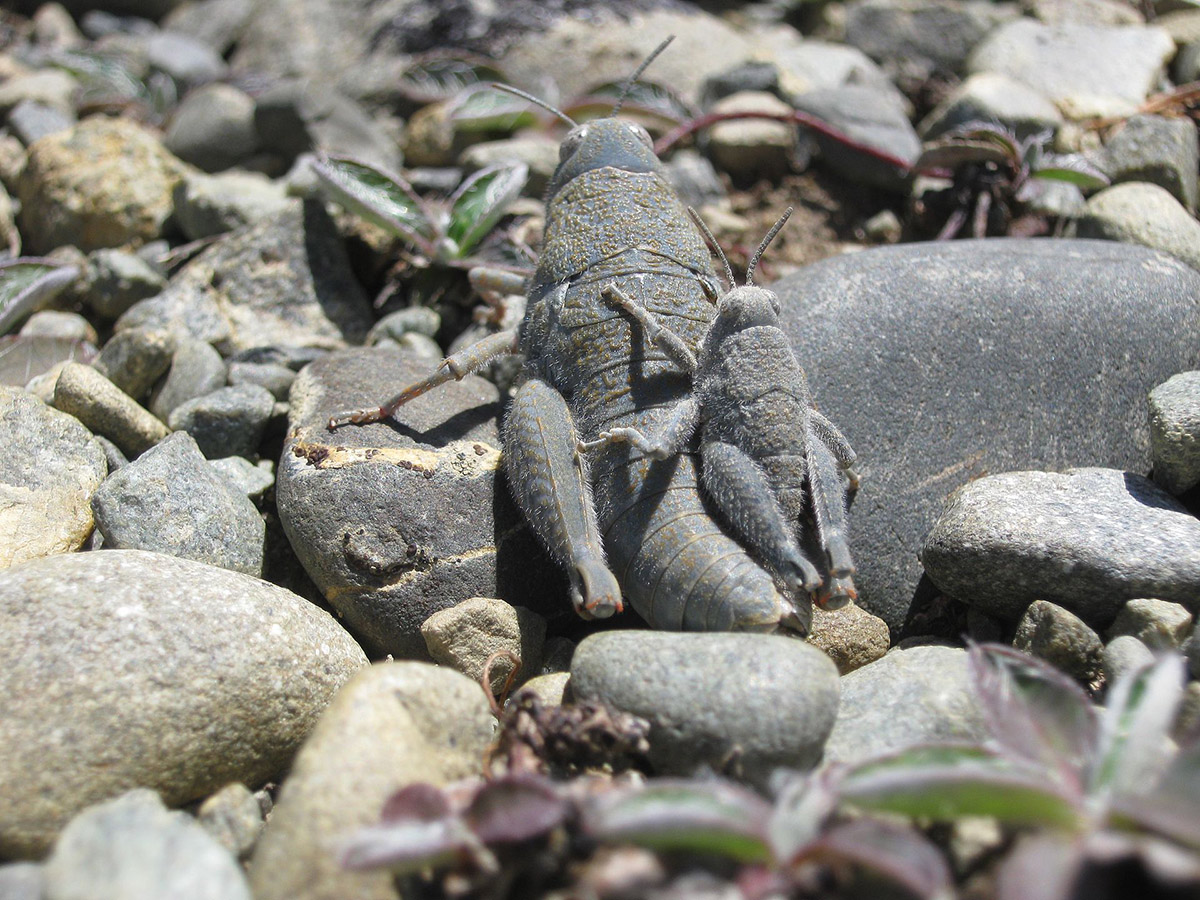
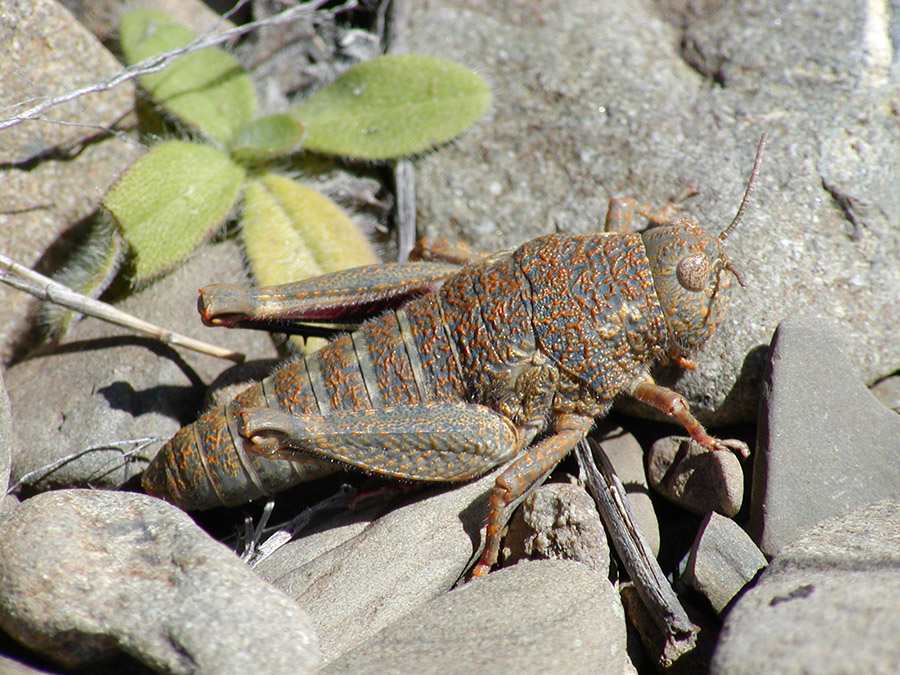
“If Game of Thrones ever needs to cast a grasshopper in fantasy armor (available in either riverstone grey, black or orange), Brachaspis robustus is a shoo-in.” – North & South, 20 April 2019
Description
While the Robust grasshopper (Brachaspis robustus), is indeed a grasshopper, they don’t live in grass and they certainly don’t hop from blade to blade. Instead, these amazing little creatures inhabit riverbeds and terraces in the Mackenzie Basin. Highly threatened, it epitomises the vulnerability and beauty of these special habitats that have been disappearing fast (see threats). And while it can hop, it’s more like a leap of faith that ends in a crash-landing—hence the armor plating.
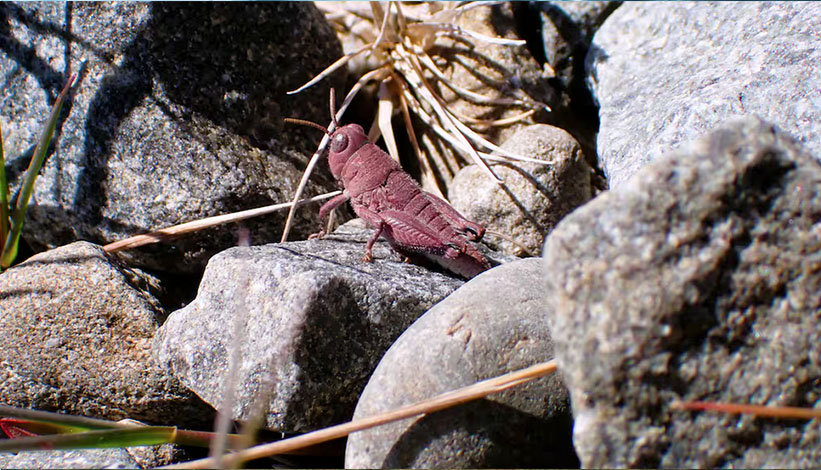
New Zealand’s largest lowland grasshopper, it’s cryptic (hard to see) amongst the stones and boulders of its specialised habitat, using camouflage as a defence against predators. Males (18-22mm) are much smaller than females (38-44mm). Like many NZ grasshoppers, they’re flightless (wings are around 1-2mm). Three colour morphs are known (or were known until 2025 when a pink variant was found): ‘Grey’ (~60%), ‘Orange’ (~40%) and ‘Black'( <0.5%). It lives for ~ 2 years. Eggs are laid from early summer to mid-autumn. Adult females probably lay two egg batches a season, each containing between 20–32 eggs. Most nymphs emerge in mid-summer, which seems to indicate the eggs require a winter period in order to develop fully. The nymphs then overwinter, often surviving temperatures well below 0°C, and reach adulthood the following summer.
It’s found only in the Tekapo, Pukaki and Ohau river catchments in the Mackenzie Basin, from Lake Benmore in the south to the upper Fork Stream in the north.
Conservation efforts
Two projects in the MacKenzie basin, where a specially designed 500m perimeter fence was installed in partnership with Te Manahuna Aoraki to exclude hedgehogs, rodents, and mustelids.
- Assessing methods for species management and monitoring techniques. This project included a University of Canterbury PhD thesis
- An MSc project to identify whether robust grasshoppers increase in population size following exclusion of predators.
More information & research
- 2021: Clements; Translocation site selection for the nationally endangered grasshopper species Brachaspis robustus Masters thesis Lincoln University
- 2020: Schori et al; Designing monitoring protocols to measure population trends of threatened insects: A case study of the cryptic, flightless grasshopper Brachaspis robustus, Plos One
- 2020: Schori; Improving the success of insect conservation translocations: a case study of the nationally endangered robust grasshopper (brachaspis robustus bigelow) PhD thesis University of Canterbury
- 2019: How a remarkable native insect is being saved (North & South)
- 2019: Saving the Robust grasshopper (Canterbury Museum)
- 2018: Schori et al; Evidence that reducing mammalian predators is beneficial for threatened and declining New Zealand grasshoppers New Zealand Journal of Zoology
- 2017: Schori: The robust grasshopper (BRaid seminar)
- 2016: Schori: Robust grasshopper population monitoring methods and conservation translocation (BRaid workshop)
- 2015 Critter of the week (Radio NZ)
- iNaturalist
- See Ecology/invertebrates for further information and references