
Black-backed gull karoro
Why is it a problem?
A scavenging bird, the population of black-backed gulls | karoro has exploded as a direct result of human activities, primarily around garbage dumps, fish processing plants, and areas where effluent is discharged. While their numbers have declined somewhat in the past few years as rubbish disposal has been improved, like all scavengers, they are opportunistic predators that readily kill river bird chicks – see the videos below – and are increasingly implicated in the failure of entire breeding colonies of critically endangered endemic black-billed gulls and black-fronted terns.
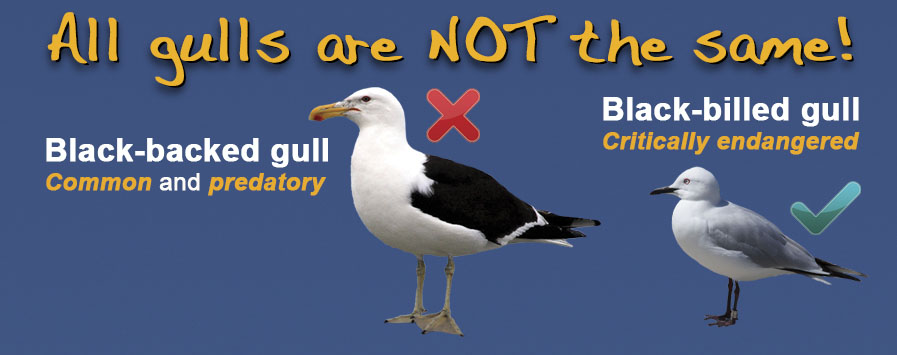
Important: in spite of their size, they are sometimes mistaken for the endangered black-billed gull tarāpuka or red-billed gull tarāpunga. To avoid fines up to $300,000 for mistaken identity, any attempt to control black-backed gulls through shooting, trapping, poisoning, pricking eggs, or any other method, should only be undertaken after consulting with ECan or DOC in your area.
Description
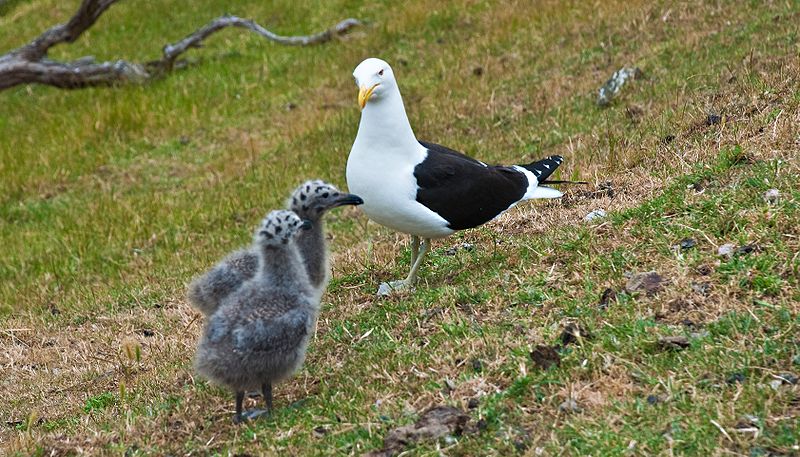
The Southern black-backed gull (Larus dominicans) karoro, (Maori), also known as the kelp gull, Dominican gull, mollyhawk, and seagull, is the largest gull and one of the most abundant large birds in New Zealand. It is also common in southern Australia, South America, southern Africa, most sub-antarctic Antarctic islands and the Antarctic Peninsula. Adults have white head and underparts with black back, yellow bill with red spot near tip of the lower mandible, and pale yellow-greenish legs. Juveniles are dark mottled brown with black bill and legs; their plumage lightens with age until they moult into adult plumage at 3 years old. Juveniles may be confused with the stockier brown skua.
Conservation activities
While Ngai Tahu regards it as a taonga species, the black-backed gull | tarāpunga is one of only two native bird species not afforded any level of protection under the Wildlife Act. Black-backed gulls | tarāpunga are often considered pests and on farmland, where some attack cast sheep and newborn lambs. As a result, they are sometimes shot, controlled using toxins, or by pricking their eggs. At a few sites, including the Waimakariri River and Hurunui River, they are controlled to reduce their predatory impacts on threatened birds.
The Canterbury Southern Black-backed Gull | Karoro management strategy outlines the rationale and recommendations for controlling the population.
More information
- 2024-25: Summary of Southern Black Backed Gull Control Works Undertaken by the Braided River Revival Team 2024 – 2025 Season (PDF)
- 2023-24: Lower Waimakariri River Southern Black Backed Gull Control An Operational Review of the 2023 – 2024 Season
- 2023-2024: Rakaia River Black Back Gull Control (Dec. 2023)
- 2023: Local movements of Karoro/Southern black- backed gull (Larus dominicanus) on the lower Hakatere/Ashburton River
- 2022: Fox, U.C. Research project (BRaid Seminar presentation) Estimating recruitment of karoro/black-backed gull to calculate egg harvest rates, with the aim of reducing a local population through egg collection (PDF; see also video above).
- 2022: Andrew Crossland; Recce of Black-backed Gulls in the Ashburton coastal farmland area autumn 2022
- 2019: WMIL; The Canterbury Southern Black-backed Gull/ Karoro management strategy
- 2019: ECan; Southern Black-backed gull-control options in Canterbury (BRaid Seminar presentation)
2024 Braided Rivers Seminar presentation: Local movements of colony-based karoro/Southern black-backed gull (PDF)
Further references and research
- 2024: Waimakariri River control and monitoring plan for Karoro/Southern Black-backed Gull (Toroa Consulting)
- 2023-2024: Lower Waimakariri River Southern Black Backed Gull Control An Operational Review of the 2023 – 2024 Season (ECan)
- 2019:(WMIL): The Canterbury Southern Black-backed Gull/ Karoro management strategy
- 2019 (ECan): Southern Black-backed gull-control options in Canterbury (BRaid seminar)
- 2018: Schlesselmann; Linking science and management for effective long-term conservation: A case study of black-fronted terns/tarapirohe (Chlidonias albostriatus) (Thesis, Doctor of Philosophy). University of Otago
- 2018: Boothby et al; 2018: An evaluation of canes as a technique to reduce predation by gulls on ground-nesting seabirds. IBIS 28 December
- 2017: Rattner and Mastrota; Anticoagulant Rodenticide Toxicity to Non-target Wildlife Under Controlled Exposure Conditions Anticoagulant Rodenticides and Wildlife pp 45-86
- 2015: Galbraith et al; Changes in the breeding status of the southern black-backed gull (Larus dominicanus) colonies on Rangitoto Island, Hauraki Gulf, New Zealand. Notornis, 2015, Vol. 62: 192-20
- 2011: Lisnizer et al; Spatial and temporal variation in population trends of Kelp Gulls in northern Patagonia, Argentina; Emu 111(3) 259-267
- 2007: Oro and Martinez-Abrain; Deconstructing myths on large gulls and their impact on threatened sympatric waterbirds Animal Conservation 10 (2007) 117–126
- 2007: Donehoer et al; Effect of Gull Predation and Predator Control on Tern Nesting Success at Eastern Egg Rock, Maine. Waterbirds 30(1): 29-39, 2007
- 2004: Cooke et al; Potential use of myxoma virus and rabbit haemorrhagic disease virus to control feral rabbits in the Kerguelen Archipelago. CSIRO Wildlife Research 03084 2007
- 2001: Guillemette and Brousseau; Does culling predatory gulls enhance the productivity of breeding common terns? Journal of Applied Ecology 200138, 1–8
- 2001: Chapuis et al; Eradication of rabbits (Oryctolagus cuniculus) by poisoning on three islands of the subantarctic Kerguelen Archipelago, Wildlife Research 28(3) 323 – 331
- 2000: Bosch et al; Short-term effects of culling on the ecology and population dynamics of the yellow-legged gull. British Ecological Society Journal of Applied Ecology, 37
- 1998: Yorio et al; Kelp Gulls Larus Dominicans breeding on the Argentine Coast: population status and relationship with coastal management and conservation Fundación Patagonia Natural and Wildlife Conservation Society, M. A. Zar 760, 9120 Puerto Madryn, Chubut, Argentina.
- 1997: Harris & Wanless; The effect of removing large numbers of gulls Larus spp. on an island population of oystercatchers Haematopus ostralegus: implications for management. Biological Conservation 82 (1997) 167-171
- 1994: Nelson; Bird Control in New Zealand using Alpha-Chloralose and DRC1339. Proceedings of the Sixteenth Vertebrate Pest Conference (1994). 40
- 1992: Wilkinson, G.B. PhD thesis, University of Canterbury; ‘Some aspects of the breeding biology of the Dominican gull Larus dominicanus (Lichtenstein 1823) in Nelson province, New Zealand’.
- 1970: Fordham and Cormack; Mortality and Population Change of Dominican Gulls in Wellington, New Zealand: With a Statistical Appendix Journal of Animal Ecology Vol. 39, No. 1 (Feb. 1970), pp. 13-27