Newsletter #109 & Braided Rivers Conference 2026 programme
Tēnā koutou katoa,
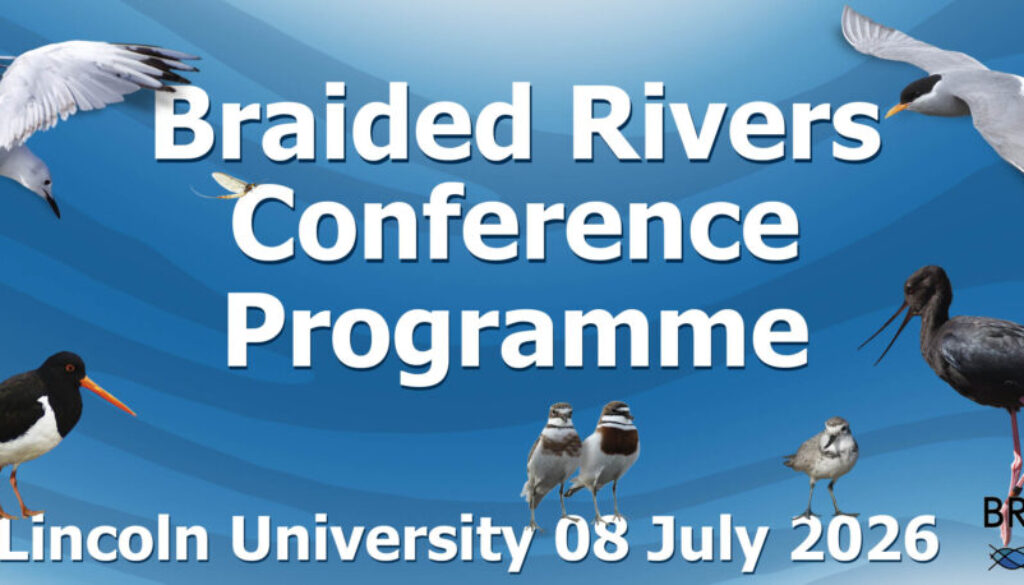
The annual Braided Rivers Conference, will be held at Lincoln University Wednesday 08 July, 2026. We have been able to keep the cost to a modest $49.00 per person in large part due to funding from the Waitaha Action to Impact Fund and a donation from artist Iain Cheeseman. Lunch, morning, and afternoon teas are included, and there is plenty of free parking at the venue (see the map). I look forward to seeing you there.
Booking is essential.
Ngā mihi,
Sonny Whitelaw
News/articles
Scimex: What NZ experts want from global meeting on migratory animals – Expert Reaction
Nature: Why I made a river my co-author “Anne Poelina gives first authorship to a source with deep knowledge about water [in Australia]— the river itself… posing a profound challenge to Western and colonial views of what knowledge is and who holds it.”
RNZ: ‘Sobering reading’: Waterways worsening around the country, report reveals “Pressures from land use, contamination, water abstraction and climate change are altering the quality and movement of water across rivers, lakes, wetlands and aquifers.”
RNZ: Conservationists alarmed by new report into New Zealand’s freshwater “Among other indicators painting a worrying picture the report said glaciers, which acted as major freshwater reservoirs for rivers and groundwater, were rapidly retreating – decreasing 42 percent between 2005 and 2023. Invasive species were having a direct impact on native ecosystems and even hydroelectric power generation. Wetlands continued to be lost or degraded, despite only 10 percent of historical wetland areas remaining.”
Newsroom: Stoush over Central Otago’s driest river enters even more troubled waters
“After years of delays and policy upheavals, an unusual bill proposal could shift control of Manuherikia River flows from regional planners to central government.”
Mongabay: Seabird nests built with plastic waste off the coast of Germany. Summary of several studies including this: “…plastic was found in 32% of herring gull (Larus argentatus) nests, 53% of great black-backed gull (Larus marinus) nests and 80% of European shag (Gulosus aristotelis) nests.”
Mongabay: How saving birds protects the planet: Interview with author Scott Weidensaul, best selling author of “The Return of the Oystercatcher: Saving Birds to Save the Planet” Note: the title refers to the the American oystercatcher Haematopus palliatus.
Mongabay: Once lost, now found: Five “missing” bird species rediscovered in 2025, offering hopeAll of the “found” birds are endemic to islands in Southeast Asia and Oceania.
Climate Connections: A powerhouse El Niño event appears to be brewing for 2026-27 Good explainer, and while it focuses on the impact the U.S., here in Aotearoa it can mean drought, increasing the demand for irrigation and the flow of foothill-fed braided rivers such as the Ashley Rakahuri to decline, even dry up.
The Conversation: A high‑risk bird flu strain is circling the globe. How prepared is NZ?
Reports & research papers
- 2025-2026 Waimakariri Black-billed Gull Monitoring Season Report (Keystone Ecology)
- 2026 : Courchap et al; Quantifying the Magnitude of Biological Invasions Using Total Biomass, Bioscience
- 2026: Hernández-Carrasco et al; Population and community responses to the fast, slow, and seasonal components of environmental variation (New Zealand rivers); Biology pre-print
- 2026: Sigid et al; On the Future of Extreme Rainfall in New Zealand, AGU