Purple willow in Canterbury Rivers. What’s the story?
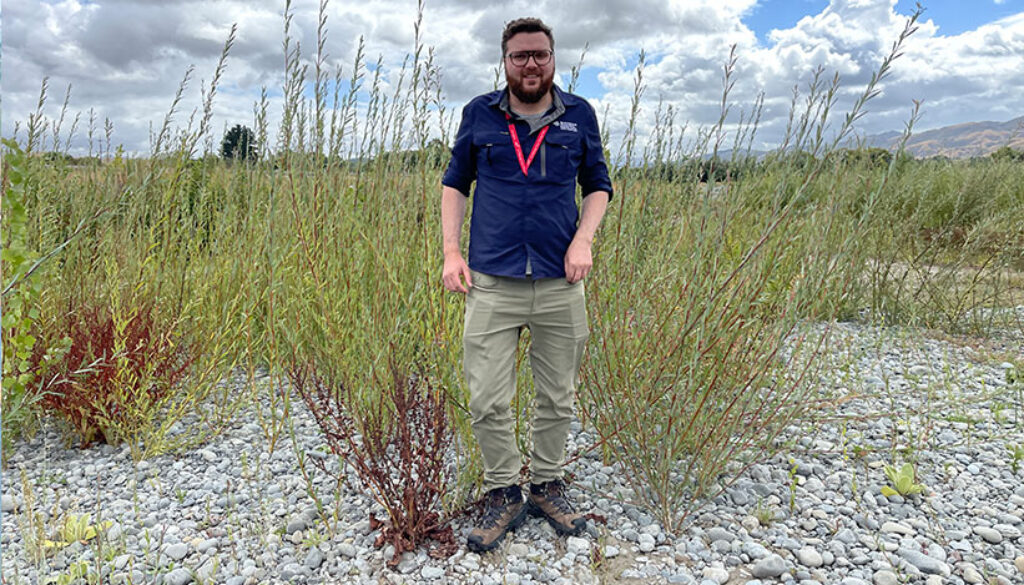
Top image: 1-year old purple willow with a dedicated human for scale
Rima Herber, Hurunui District Council’s Water and Land Coordinator, chaired a Hui last month on Purple Willow, which is quickly becoming a pest plant of concern. The aim of the meeting was to share information, discuss control measures, and to raise awareness.
Purple willow (Salix purpurea) is a growing threat to biodiversity in Canterbury, due to its relatively recent ability to set seed. A lot of it. Planted for erosion control, bank stabilisation and basketry, this hardy, unpalatable willow is now spreading through Canterbury river systems. Predictably, the same characteristics that make it so useful, (fast growing, hardy, frost and drought tolerant, good for binding the substrate, resistant to browsing), are what are making it a hideous weed. Purple Willow is establishing in river gravels, river berms, slips, road margins, pasture, and upper catchments.
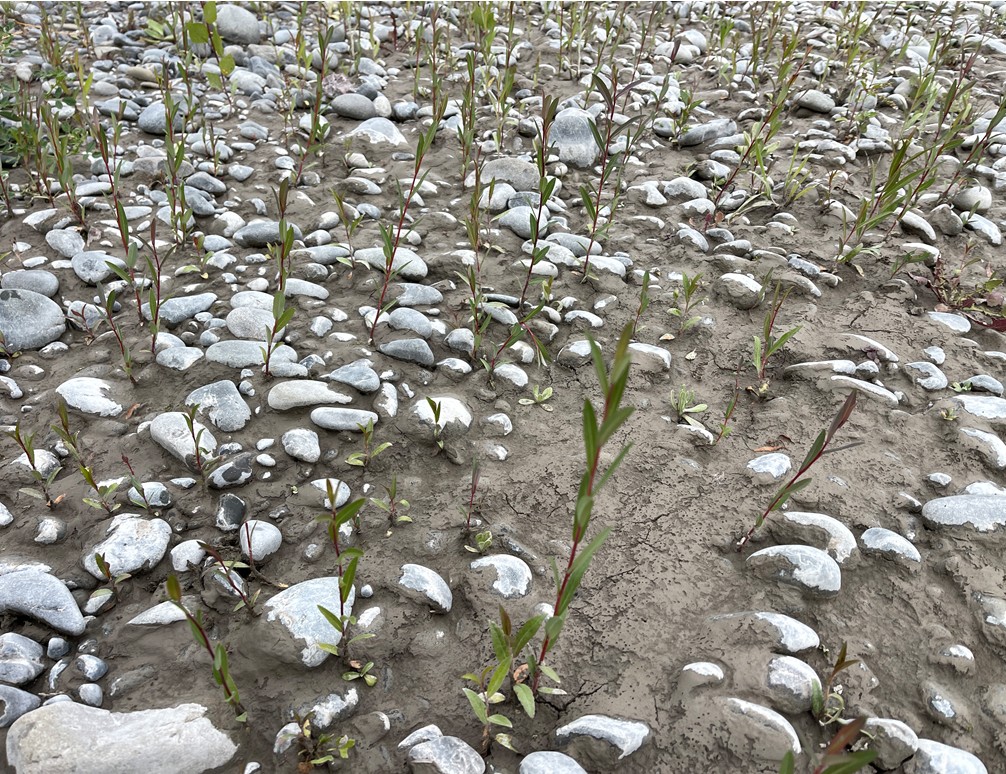
The light, windborne seeds can travel great distances, and masses of fast-growing seedlings can quickly create areas of dense vegetation. In riverbeds and river berms, this vegetation traps sediment, changes the course of rivers and creates habitat for pest animal species.
The reasons for its ability to set seeds are unknown, as in most cases care has been taken to only plant sterile clones. It is becoming clear that single-sex clones are not always reliably sterile, and occasional female catkins have been found on male ‘sterile’ clones.
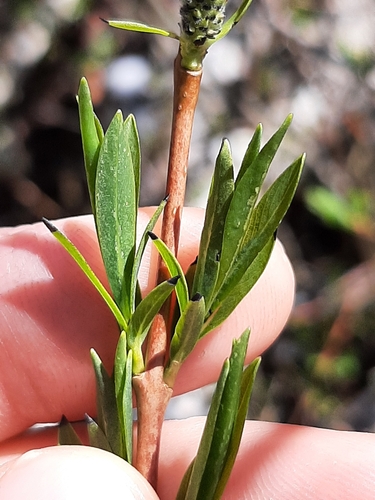
Purple willow is a shrub willow. It is multi-stemmed, with dozens of stems growing up from the ground.
It can re-root where stems are buried by silt and has very deep roots. Its spread is assisted by wind-blown seed, gravel movement, machinery, recreational vehicles and historical planting. Control is expensive, and due to the shrubby growth, normal methods of manual control, such as cutting and pasting stems, and drill and fill, aren’t practical. It is also known as bitter ‘willow’ as stock don’t browse it, and it seems that none of the pathogenic agents that attack willows in NZ have been found on purple willow. Also known as a basket willow, the flexible stems can bend and then recover when rivers flood, another feature of its resilience in the environment.
Current information on distribution remains incomplete, and it would be helpful if sightings can be loaded onto iNaturalist, particularly sightings that are outside of the known areas of infestation.
A point that was brought up at the meeting is that we need to cast our minds forward five and ten years, and develop a clear picture of how things could look if this problem isn’t adequately addressed at this stage. Indications are that this weed has the potential to have as negative an impact on the environment as wilding conifers, and there is a clear call from those at the meeting for a plan of action to prevent that from becoming the case.